

If you work in support, you’ve probably noticed how quickly AI has become part of everyday life. When the first LLMs started becoming available to the public, we, like a lot of other companies, saw an opportunity to improve how we support our users. At the time, we already had a chatbot that worked a bit like a search engine, helping people find answers in our documentation.
That worked well, but we’ve always been especially proud of the human side of our support. We wanted to make it easier for users to get faster answers and quicker resolutions, without losing the personal, thoughtful, and grounded experience we’ve worked hard to build over the years. Putting a “conversation” in front of the human side of support was not something we wanted to do lightly. If we were going to do it, we wanted to make sure the focus stayed on creating the best possible customer experience.
That’s where Odie (short for Odysseus) comes in. You may have already seen Adeline’s blog post about Odie, but we wanted to share a bit more about how we think about it from the support side.
More than a chatbot
Odie is Automattic’s internal AI assistant platform. It powers support experiences across WooCommerce and WordPress.com chats and emails, and it also shows up in different ways across other products. But Odie is more than just a chatbot. It’s a persona, a bot with a job to do and a personality to match.
We’ve spent a lot of time thinking about how Odie should sound, respond, and show up in a conversation. We want it to reflect the spirit of our support: helpful, clear, and just a little playful. Just as importantly, we want it to respect the warm tone and voice that matter so much to us.
That has taken a lot of work. It’s not only about making sure the information is useful, but also that it feels right. A response can be technically correct and still miss the mark if it feels cold or disconnected from the person reading it.
Behind the scenes
That’s why we created our AI Squad, a team of Happiness Engineers focused on reviewing interactions, polishing the experience, and helping shape Odie into the most helpful possible first stop in support. On the technical side, that means spotting unexpected or incorrect responses, tracking patterns, and suggesting improvements. On the human side, it means paying close attention to tone, clarity, and whether the experience actually feels supportive.
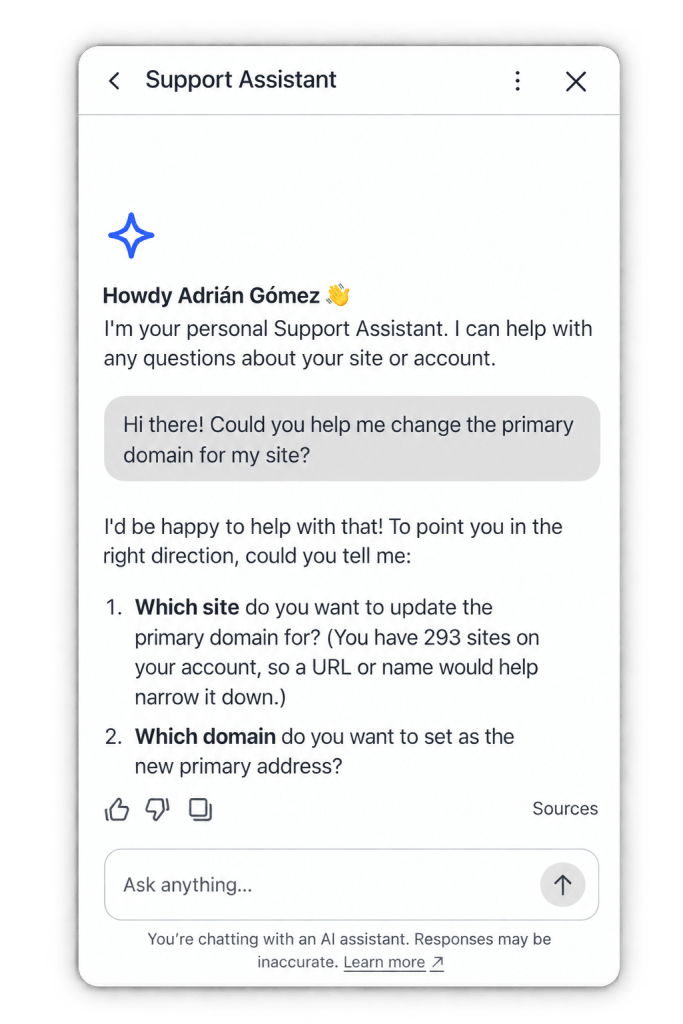
One example from earlier this year came from a pattern Happiness Engineers kept seeing: lots of users needed help with domain management tasks that didn’t always need a human in the loop. After plenty of testing, review, and guardrails, we gave Odie the ability to take care of some of those requests directly. So now, for the right kinds of domain tasks, Odie can jump in and help right away, with Happiness Engineers still close by if needed.
Still human
That balance matters a lot to us. Odie was never meant to replace the people behind support but to help users get answers faster, help Happiness Engineers work more effectively, and make the overall experience smoother for everyone.
Some conversations still need a person, and that’s exactly as it should be. What we want is for Odie to make the path to help feel easier, not more distant, a little less “where do I even start?” and a little more “okay, I’ve got this.”
If there’s one thing we hope people take away, it’s this: Odie was built around the support experience we care about most, one that is fast and useful, but still feels human.
If you’re curious to meet Odie for yourself, head to https://wordpress.com/support/ and drop a question into the “Ask us anything” box, or pick one of the suggestions below it to get started. And you can also find Odie waiting for you inside your WordPress.com account.


Leave a comment